

Manzanar Co-op Photo Studio
Exposing expressions of dignity
Posing for a Portrait

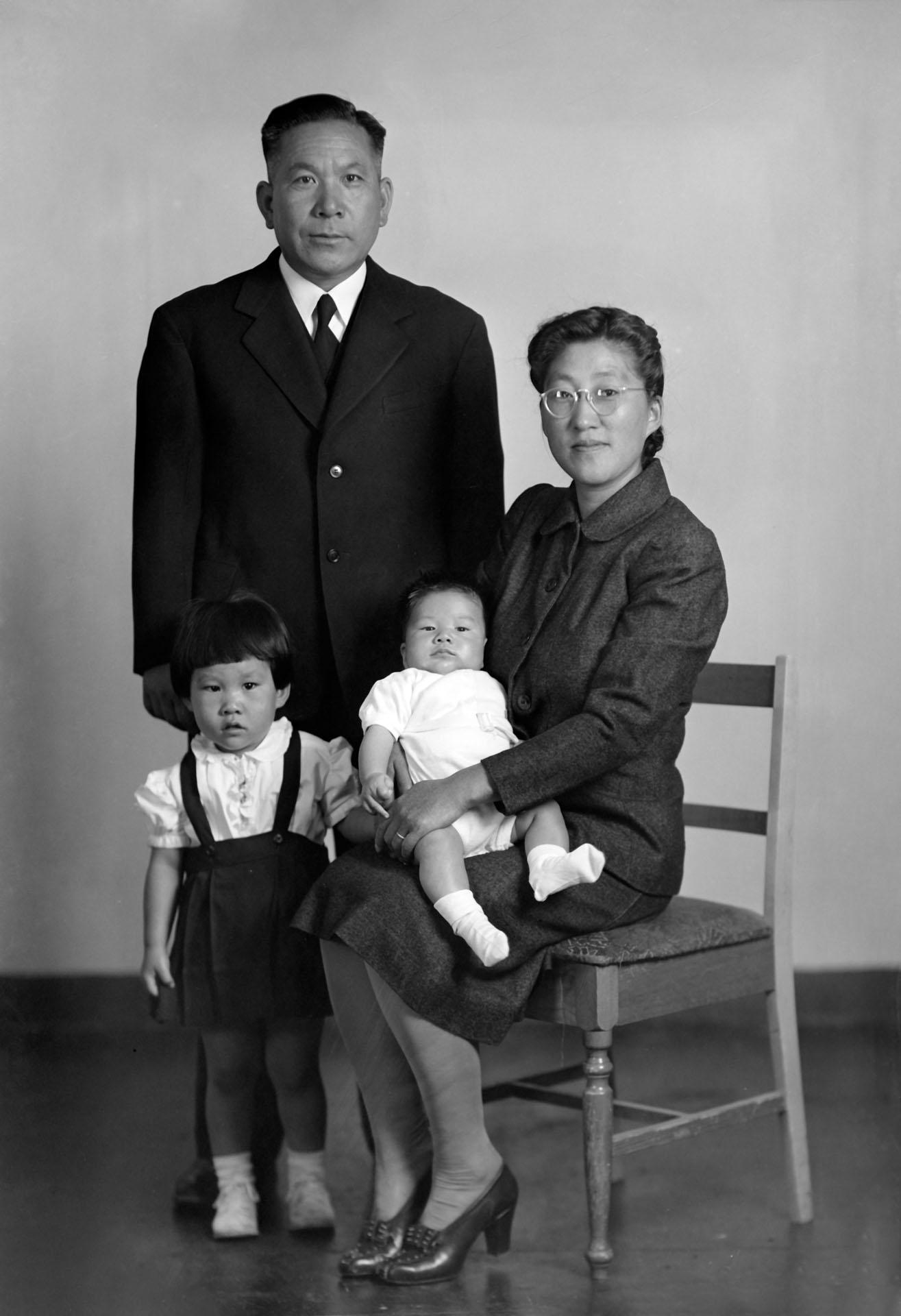
This group portrait presumably captures three generations within a family. Masako Frances and John Teruo Asahara and their four children, Tomoko Carol, Seiji David, Naoya Francis, and Kazuyoshi Paul, pose for this portrait with a couple who are presumably the children’s grandparents. The men are dressed in suits, the women in skirts and collared shirts, while the children are dressed sharply, too. This family portrait is reminiscent of those commonly taken at Toyo Miyatake Studio in Little Tokyo before World War II, yet a closer look reveals the austere barracks’ flooring in the lower right corner of the image. Just like their peers, the Asahara family was profoundly impacted by the forced removal from their home on the West Coast, which is apparent from the worried expressions on the adults’ faces.
Yet, through the creation of this keepsake, Toyo Miyatake and the Manzanar Photo Studio staff adroitly gave incarcerees the respectability that had been so cruelly stripped from them.
Manzanar Co-Op Photo Studio
The Manzanar Co-op Photo Studio opened in Block 30 to provide photography services ranging from single portraits and portraits of families to weddings and funerals. Toyo Miyatake managed the photo studio staffed by noted Japanese American photographers Jack Iwata, Hisao Kimura, and Timothy Saito.
High demand for appointments reflected incarcerees’ desire to capture precious moments that persisted, despite their unjust confinement. The Manzanar Co-op Photo Studio was a busy enterprise. As Miyatake and the other photographers framed their shots, they gave fellow incarcerees a sense of dignity amidst the injustice surrounding them.
The photos displayed below are a selection of images from the Manzanar Portrait Studio collection. The Manzanar Portrait Studio collection contains portraits that Toyo Miyatake and his staff at the Co-op Photo Studio captured for clients. While a majority of photographs in this collection were taken inside the Co-op Photo Studio at Block 30, the collection also includes posed photographs from events such as weddings, funerals, and other events throughout the camp.
Click on the images below to learn more about the stories behind the photographs.
From Behind the Camera
Toyo Miyatake employed a number of photographers and assistants at the Manzanar Co-op Photo Studio, many of whom were established photographers in Los Angeles before the war. Explore the photos below, including image information, to learn more about the employees and their vital contributions to the success of the Photo Studio.

Through the Manzanar Cooperative, Toyo Miyatake employed and managed a number of staff who helped take, develop, retouch, and process the photographs you see in this exhibition.

Archie assisted Toyo in photographing events at camp, developing photos in the darkroom, and even traveling to Arizona to take commissioned photographs at Poston and Gila River.

Although seldom recognized, Hiro Miyatake made invaluable contributions to the success of Toyo Miyatake Studios across decades of hardship and change.

While incarcerated at Manzanar War Relocation Center during World War II, Hisao Kimura was hired by Toyo Miyatake as a photographer, developer, and photo retoucher at the Co-op Photo Studio.

George Shiba was employed by the Co-op Photo Studio to assist in the darkroom and help take event photographs.

While at Manzanar, Saito was one of the main photo and print retouchers at the Co-op Photo Studio.

Jack Iwata began working at Toyo Miyatake Studios in 1937. While at Manzanar, Iwata was one of Miyatake’s top photographers at the Co-op Photo Studio.

The Co-op Photo Studio included several other staff in various capacities.
A Day at the Studio
Explore photos of the Co-op Photo Studio and its staff performing day-to-day activities.
Studio Equipment
In addition to staff at the Co-op Photo Studio, Toyo Miyatake also needed photography equipment to run the operation. At the time, a studio needed to have equipment for the entire process: taking photos, developing photo negatives, and making prints for customers.
Rather than purchasing new gear for the Co-op Photo Studio, the Manzanar Cooperative signed an agreement with Toyo Miyatake to lease his equipment for use in the Co-op Photo Studio. This contract details the terms of their agreement, with a full list of the leased equipment. Once Miyatake received his equipment from storage in Los Angeles, the Co-op’s new studio was set up in the Ironing Room of Block 30. The Co-op Photo Studio officially opened for business on April 13, 1943.
Explore the photo gallery below to learn more about some of Toyo Miyatake’s equipment that was used at the Manzanar Co-op Photo Studio.
Beyond the Portrait
The Co-op Photo Studio served over 1400 unique clients over the course of its operation between 1943 and 1945. Below are several profiles that highlight unique stories of families at Manzanar and beyond.
Hirosawa Family
On March 31, 1942, Frank Hirosawa and Sachiko Shimbo married, a life event that would normally signify an auspicious future ahead. The couple was building toward this as Frank was finishing his graduate education in organic chemistry and Sachiko was studying fashion design at Woodbury College and working as a seamstress. Yet, a month later, they were forced from their home in downtown Los Angeles and sent to the Santa Anita temporary detention center.

Frank and Sachiko arrived at Manzanar on June 9 and were assigned to block 31, building 10, apartment 3. When they arrived, Sachiko was pregnant with the couple’s first child, Julia Sayoko, who was born on February 1, 1943.
Frank’s brother Shigeo Stephen Hirosawa was also incarcerated at Manzanar until he left for Camp Savage in Minnesota in June 1943 to begin training at the Military Intelligence Service Language School. Shigeo served as a translator in the Pacific theatre and continued to live and work in Japan after the US occupation ended.
While Shigeo was in the military, Frank was also helping the home front and advancing his career at Manzanar. Frank’s organic chemistry background secured his participation with a scientific research group tasked with the Guayule Project, to devise a way to make rubber out of the guayule shrub for military use. Frank was integral in discovering a natural rubber substitute.
The Hirosawa family expanded in July 1944 with the birth of their second child, Nobuyuki Ronald Hirosawa. The Hirosawa family left Manzanar on November 13, 1945 and went to live with Sachiko’s family in Chicago. They lived in Chicago for about a year before returning to Los Angeles.
Since the Hirosawas were unable to return to their prewar home, they were grateful to the Miyatakes for offering them a place to stay. The Miyatakes, who returned to their home in Boyle Heights in 1945, supported the Hirosawas, allowing them to stay with them for about four years. One of Ron’s first memories include him falling off the Miyatake porch into a rose bush when he was about five.
When Frank secured a long term job as an organic chemist in the epoxy industry, the Hirosawas moved into a nearby house. Ron graduated from Roosevelt High School in 1962 and later from Cal State LA. He became a teacher and worked for LAUSD for 39 years. Ron taught Roosevelt High School’s first Asian American Studies class and later became an administrator at Roosevelt, his alma mater.
These photos show the Hirosawa family at Manzanar. The relationships that the Hirosawa family furthered at Manzanar were long-lasting.
Mayeda Family
Sangoro and Hideko Emily Mayeda were amongst the first to arrive at Manzanar on June 1, 1942, following their forced removal from Florin, CA. Sangoro, who was active with the Florin Buddhist Church, became involved with Buddhist services and events at Manzanar. At Manzanar, the Buddhist and Christian churches held services in the various recreation halls that were in each block. The Buddhist Church was headed by Rev. Shinjo Nagatomi, but he couldn’t do all of the services and events alone. Sangoro began to lead some of the Buddhist services. The Buddhist Church also put on community events like the hanamatsuri (spring festival) and summer obon, which helped to create community and a sense of normalcy.
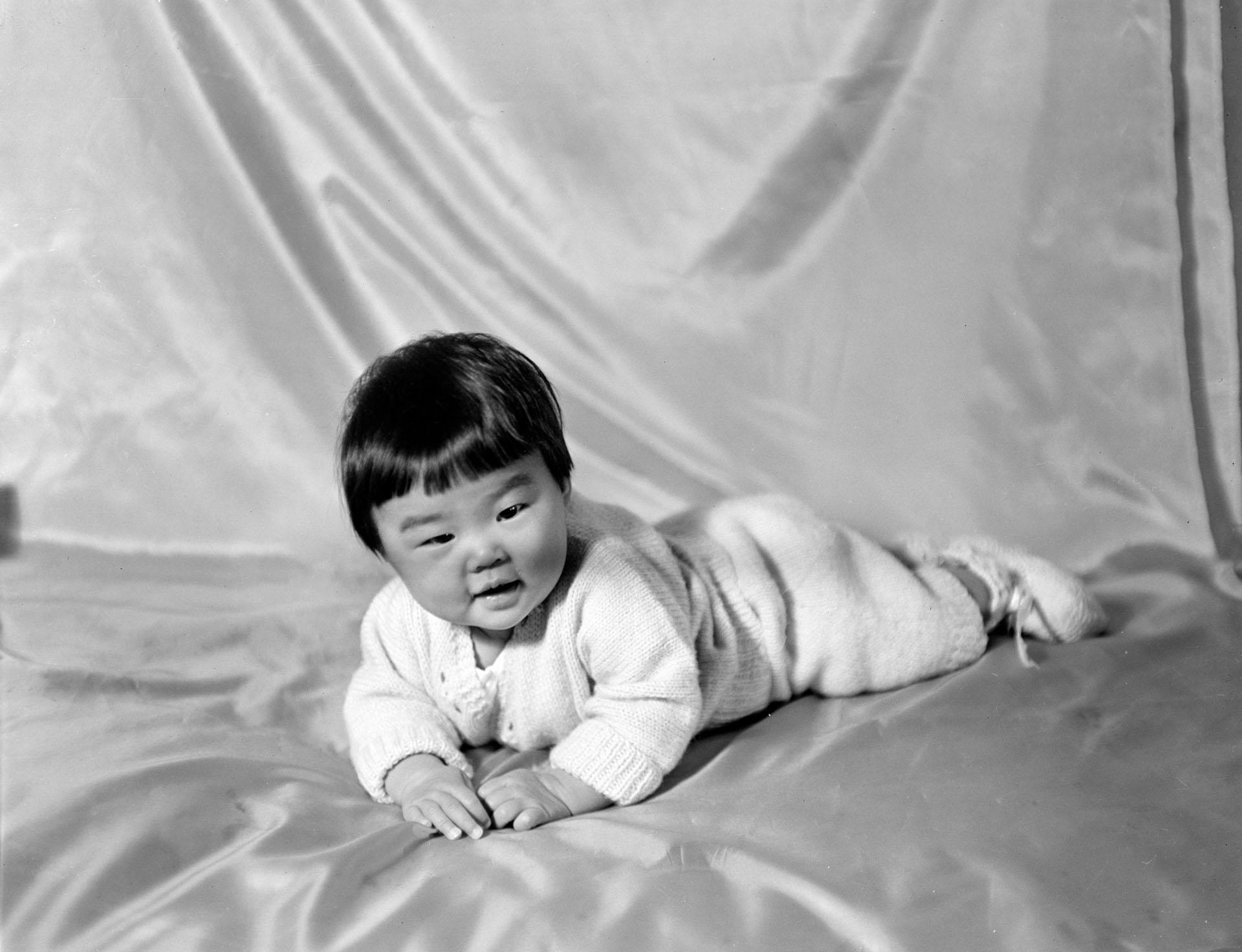
While at Manzanar, the Mayeda family grew with the birth of Fumi Mayeda in February 1943 and Makoto Mayeda in June 1945. Makoto was 5 months old when the Mayeda family left Manzanar on November 19, just 2 days before its closure.
The Mayeda family resettled in Venice. Sangoro worked as a gardener and Hideko Emily worked as a domestic servant, but life in Venice was hard for the Mayedas. Through it all, Sangoro and the Mayeda family stayed connected with their Buddhist faith and involvement in the church.
In the 1950s, Mayeda was asked to go back to Manzanar and perform services for those still buried at the camp. The Mayeda family helped to clean up the land and participated in a service at the Ireito (consoling monument). The Mayeda family would return to Manzanar every year, long before there were pilgrimages.
In the 1960s, young Sansei wanted to connect to their families’ experiences at Manzanar. A number of people joined Sangoro and his family, which led to the first Manzanar pilgrimage in December 1969.
Sangoro’s work as a reverend and diligence to go to Manzanar every year to remember what took place there, lead to healing for generations of Japanese Americans who continue to pilgrimage to Manzanar annually.
Shima Family
On October 12, 1942, Mary Yoshiye and Shingo Shima entered Manzanar after six months at the Santa Anita temporary detention center. At Manzanar, they rejoined their respective families.
Prior to incarceration, Mary and Shingo worked at the Shima family’s nursery in Inglewood, which specialized in succulents.
At Manzanar, Shingo was a carpenter and Mary was the social director of events. Mary coordinated community events, working mainly with teenagers in an effort to create a better quality of life. Events like the “Spring Fever” dance intended to bring joy and a sense of normalcy.

At Manzanar, Shingo was a carpenter and Mary was the social director of events. Mary coordinated community events, working mainly with teenagers in an effort to create a better quality of life. Events like the “Spring Fever” dance intended to bring joy and a sense of normalcy.
Meanwhile, Shingo found joy in a new hobby. Through another incarceree, a woman semi-pro golfer, Shingo learned how to play golf. He set up a course using tin cans as holes. Shingo continued golfing after leaving Manzanar, playing every Sunday.
Because of the Shima family’s expertise in succulents, Shinkichiro Shima, Shingo’s father, was placed onto the Guayule Project due to his experience in growing similar plants to guayule. He helped to grow and convert guayule into rubber, which proved successful.
Mary and Shingo’s first child, Carolyn Yuriko, was born at Manzanar on March 16, 1944. Raising a baby in Manzanar was not easy. In a letter Mary wrote to her friend Chiye Yato who had already left camp, she wrote about the hardships, including the intense winter and how Carolyn had been quarantined with chicken pox. She also lamented her wish to leave. She noted to Chiye: “If it's this cold here it must be pretty bad out where you people are. But it's worth it to be out of here at least your lives are full of living while we just stagger throughout days with little hope for the next day.”
The Shimas left Manzanar in August 1945. Though they fortunately had a home to return to, the transition was still very hard. Extreme prejudice toward Japanese Americans after the war lingered, which made it uncomfortable for the Shimas to leave the nursery. Along with the prejudice, work at the nursery was hard and not profitable. As Mary and Shingo’s children went to school, Mary encouraged them to work hard to get a higher education so they wouldn't have to work in the nursery.
Along with urging her children to excel, Mary wanted her children to remember the experiences their family had undergone during the war. She talked about her experiences in camp with her children and urged them to make the best of their lives.
Creative Framing at Manzanar
In addition to the portraiture taken in the Co-op Photo Studio, Toyo created artistic photographs from the surroundings at Manzanar. Miyatake was able to have his stored photo studio gear delivered from Los Angeles, providing a variety of cameras for him to take photographs with. While there are no records to clearly indicate which camera was used for each photograph, it is likely that the following fine art photographs were taken using a combination of Toyo’s Camera and other cameras from Miyatake’s collection. In all cases, Miyatake’s artistic vision and unique relationship with lighting are prominently displayed in the gallery below. These photographs represent a small portion of what Toyo Miyatake Studio calls The Official Set.